
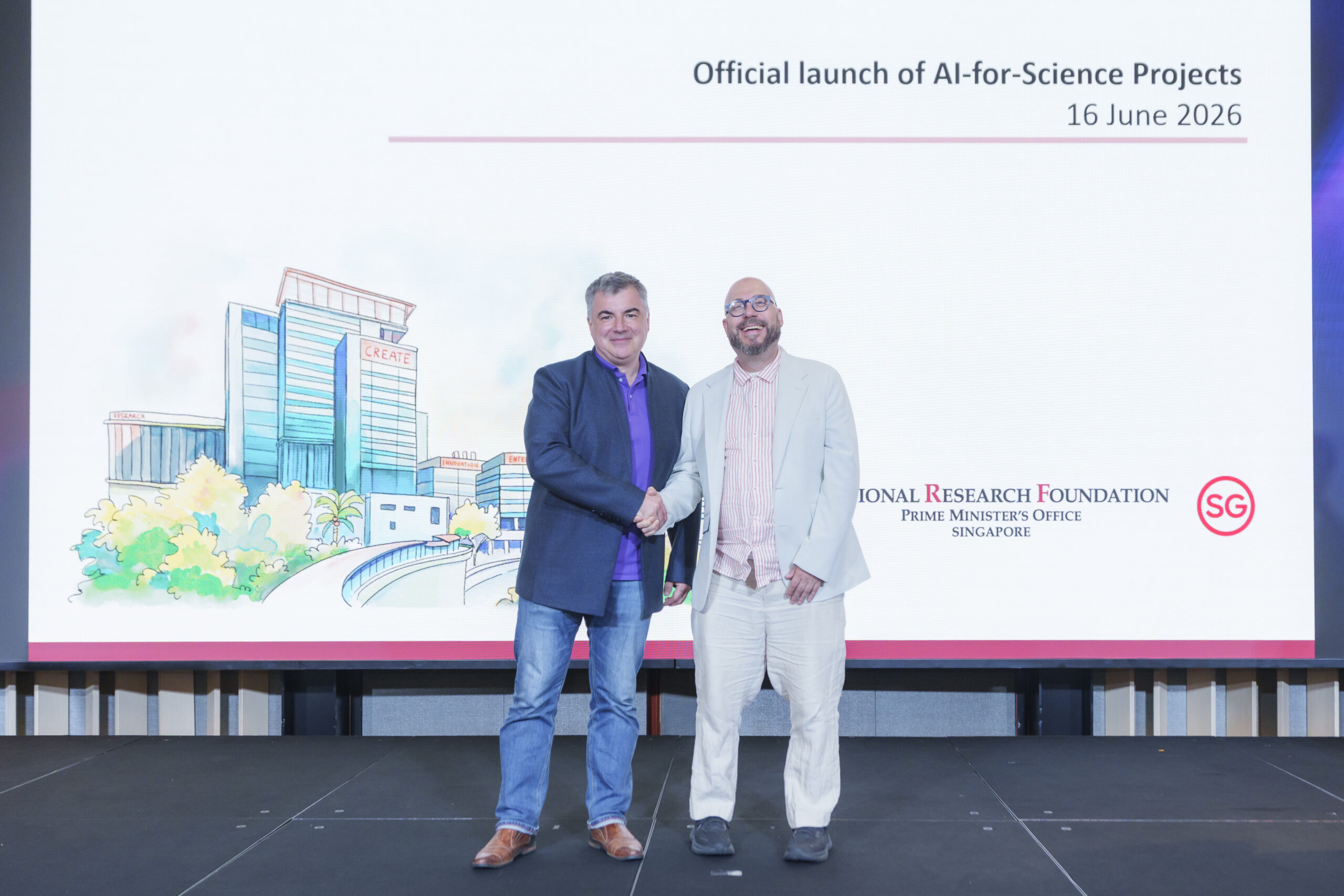
Left: Professor Sir Konstantin Novoselov, Director of the Institute for Functional Intelligent Materials (I-FIM) at the National University of Singapore. Right: Professor Alán Aspuru-Guzik, Director of the Acceleration Consortium at the University of Toronto.
PRESS RELEASE
National University of Singapore and University of Toronto launch the Materials Data Foundry to fast-track discovery of functional materials with AI and robotics
NUS Institute for Functional Intelligent Materials (I-FIM) and U of T’s Acceleration Consortium (AC), in collaboration with Nvidia and VeChain industrial partners, will build an open autonomous lab to create the world’s most comprehensive experimental materials property dataset. This data will power AI models to accelerate advances in electronics, energy and infrastructure.
Highlights:
- The lack of large, high-quality datasets for materials is impeding the use of AI to accelerate the high value materials
- I-FIM (National University of Singapore) and the Acceleration Consortium (University of Toronto) are launching the Materials Data Foundry to establish an open autonomous lab in Singapore and build a unified, multi-fidelity dataset for solid-state materials.
- The Foundry will create real-world material performance data using AI, robotics and in-situ characterisation.
- The lab will apply its platform to three testbeds: beyond-silicon and quantum-topological materials, durable oxygen-evolution electrocatalysts and corrosion-resistant high-entropy alloy coatings.
- Key deliverables include datasets containing tens of thousands synthesis reactions, multi-modal foundation models that propose synthesisable candidates and an open software/API stack to speed translation from lab to deployment.
- The collaboration to include Nvidia and VeChain industrial partners to gain access to the most up to date digital solutions on the market
Singapore, 16 June 2026 — The Institute for Functional Intelligent Materials (I-FIM) at the National University of Singapore and the Acceleration Consortium (AC) at the University of Toronto have partnered to develop the Materials Data Foundry (MDF), responding to a critical bottleneck in materials innovation: the lack of large, high-quality, standardised datasets that is impeding the effective use of artificial intelligence (AI) to accelerate the discovery and deployment of high-value materials.
The MDF fixes the missing link by capturing recipes and results together, so AI can recommend not just what to make, but how to make it — reliably and at scale. This dataset will help shorten the path from idea to industrial use in various high-value sectors, from beyond-silicon electronics to clean energy and durable infrastructure.
Through the creation and development of an open autonomous lab in Singapore that integrates multi-modal AI with high-throughput robotics and in-situ measurements, the MDF will create the largest real-world dataset of synthesis routes and properties for solid-state materials.
The MDF has received a grant award of close to S$10 million from Singapore's National Research Foundation (NRF), building on initial seed funding from U of T and NUS. The MDF is among the eight inaugural projects awarded under the S$120 million AI-for-Science (AI4S) Initiative. The official launch of these projects was announced by Professor Tan Chorh Chuan, Permanent Secretary (National Research and Development), at the AI4X-Accelerate Conference 2026. The Initiative, which supports the National AI Strategy 2.0 (NAIS 2.0) in building up a vibrant and innovative AI research ecosystem, brings together teams of AI researchers and scientific domain experts from Singapore and top international institutions to develop AI methods and tools that can raise research productivity and accelerate discovery.
“Synthesis pathways of materials encode their composition, structure and morphology, thus determining their realistic properties,” said Professor Sir Konstantin Novoselov, Director of I-FIM, who won the 2010 Nobel Prize in Physics for his world-changing experiments regarding the two-dimensional material graphene. “The MDF turns abstract predictions into practical recipes by feeding real synthesis data into AI models.”
I-FIM and AC will join forces with Nvidia and VeChain industrial partners to integrate the computational and experimental materials data efficiently. The industrial partners will also help develop reaction-landscape datasets and the AI- and blockchain-enabled algorithms to identify the optimum reaction pathways and conditions.
Why this matters
Modern technologies lean on complex solids, for example, two-dimensional semiconductors for energy-efficient computing, mixed-metal oxides for green hydrogen, and corrosion-resistant alloys for sustainable infrastructure. However, materials discovery is a major bottleneck.
Existing computer simulations assume ideal conditions, assuming thermodynamically stable states, while current AI tools often predict properties for simplified crystal structures while ignoring defects, entropy and, crucially, synthesisability. All this leads to thousands of promising, computer-suggested materials but far too few can actually be made to work in the real world.
The MDF fills a critical gap by linking synthesis recipes with their outcomes, enabling AI to recommend not only which materials to make, but also the best way to make them — reliably and at scale. In particular, the MDF addresses two core problems at once:
- Data scarcity and bias: high-fidelity experimental data is limited and scattered.
- Design without a recipe: most models do not encode synthesis pathways — the step-by-step conditions that create phases, defects and morphologies that determine performance.
“Our goal is to accelerate science for solid-state materials,” said Professor Alán Aspuru-Guzik, Director of the Acceleration Consortium. “Predicting the structures of materials is simply not enough now. We are closing the loop between AI suggestions, robotic synthesis and in-situ feedback — tracing the paths that lead to new working materials that make an impact in the real world.”
Materials Data Foundry: Bridging recipes and results for faster materials discovery
Above all, the MDF is a unified, multi-fidelity data engine. The Foundry will fuse heterogeneous inputs — high-throughput experiments, in-situ spectra, phase diagrams, microscopy and multi-scale simulations (such as DFT, MD, Monte Carlo) — into standardised, open datasets that explicitly record synthesis steps, intermediates and outcomes. This becomes training fuel for foundation models that predict both properties and viable routes to achieve them, including out-of-equilibrium phases and defect distributions.
The MDF is also an autonomous, open experimentation lab. It will deploy robotic synthesis tuned not merely to cover composition space, but to span alternative synthesis routes (gas/solid precursors, temperature–pressure histories, growth rates), while logging intermediates via mass spectrometry, gas chromatography, Raman and PL. Downstream testing modules will characterise electronic, optical and catalytic performance and feed results back to the models in real time, forming a backbone for MDF operation through digital lab integration and active-learning loops for AI-driven experimentation.
In addition, the MDF will be an algorithmic navigator of synthesis. New AI frameworks — combining Markov models of reaction steps, stochastic differential equation surrogates of macroscopic dynamics and Monte Carlo Tree Search — will explore the “synthesis landscape” under constraints such as energy use, cost or environmental impact. Learning from success and failure in situ enables the frameworks to avoid dead ends and converge on robust, scalable recipes.
A key novelty lies in using machine learning interatomic potentials (MLIPs) near saddle points, coupled with advanced saddle-point search methods and uncertainty quantification. This will enable the creation of the first large-scale database of reaction landscapes and AI-assisted optimisation and control algorithms that operate directly on reaction-route graphs.
This integrated approach to reaction landscape modelling and control is genuinely novel and may lead to significantly shortened paths from lab discovery to deployable materials in various high-value sectors, from beyond-silicon electronics to clean energy and durable infrastructure. Furthermore, Kinetics- and transition-aware generative frameworks represent a significant step forward in our capabilities. Digital lab integration and active-learning loops: This highlights the practical application and dynamic nature of our research.
“Linking routes to results is the missing layer,” noted Associate Professor Kedar Hippalgaonkar, Principal Investigator at I-FIM. “The MDF will make standardised schemas and APIs openly available so other researchers can plug their data and tools into the Foundry — building a commons for practical materials discovery.”
Key priorities
In its first phase, the partnership focuses on three areas where better materials enable near-term gains:
- Low-power and quantum-ready electronics: routes to beyond-silicon and topological materials for cooler, more efficient chips and spintronic devices.
- Clean hydrogen production: mixed-metal oxide electrocatalysts engineered for >10,000 hours at 2 A/cm² and full-cell voltages around 1.7 V — translating to weeks of industrial operation without performance drop.
- Long-life coatings: corrosion-resistant high-entropy alloy coatings for lightweight magnesium alloys that outlast commercial Zn–Ni on steel.
Across these testbeds, the MDF will deliver:
- The world’s largest open materials dataset built from 50,000 high-fidelity experiments.
- Multi-modal, multi-fidelity foundation models that generalise across compositions and conditions and propose candidates under cost and energy constraints.
- Open software and APIs to query, visualise and integrate the MDF with external data and self-driving labs.
- Best-practice protocols for data fusion and for building scalable automated materials labs.
- Pathways to pilot manufacturing with industry partners.
“The MDF is designed for impact and not just publications,” said Professor Jason Hattrick-Simpers at the University of Toronto. “The Foundry’s outputs — data, models and validated recipes — are built to shorten the road from lab discovery to deployable materials.”
The MDF project benefits from strong existing collaborations with industry partners like Nvidia, SEA, and VeChain, facilitating access to top talent and joint PhD programs. Additionally, this initiative leverages I-FIM and AC’s extensive international collaborations with institutions such as Berkeley, Imperial College, RIKEN, University of Tokyo, and ETH-Zurich, to further strengthening research and discovery.
This new approach for creating a synthesis database and navigating reaction landscapes is highly scalable and applicable across a wide range of materials, including metal alloys, oxides, organic molecules, MOFs, and hybrid materials. By using advanced modelling methods to learn from smaller datasets and expand to much larger materials spaces, it provides a strong foundation for long-term impact and sustained global collaboration.
About National University of Singapore (NUS)
The National University of Singapore (NUS) is Singapore’s flagship university, which offers a global approach to education, research and entrepreneurship, with a focus on Asian perspectives and expertise. We have 15 colleges, faculties and schools across three campuses in Singapore, with more than 40,000 students from 100 countries enriching our vibrant and diverse campus community. We have also established more than 20 NUS Overseas Colleges entrepreneurial hubs around the world.
Our multidisciplinary and real-world approach to education, research and entrepreneurship enables us to work closely with industry, governments and academia to address crucial and complex issues relevant to Asia and the world. Researchers in our faculties, research centres of excellence, corporate labs and more than 30 university-level research institutes focus on themes that include energy; environmental and urban sustainability; treatment and prevention of diseases; active ageing; advanced materials; risk management and resilience of financial systems; Asian studies; and Smart Nation capabilities such as artificial intelligence, data science, operations research and cybersecurity.
For more information on NUS, please visit nus.edu.sg.
About the Institute for Functional Intelligent Materials at the National University of Singapore
Launched on 7 October 2021, the Institute for Functional Intelligent Materials (I-FIM) is the world’s first institute dedicated to the design, synthesis and application of Functional Intelligent Materials. Hosted at the National University of Singapore (NUS), I-FIM is Singapore’s sixth Research Centre of Excellence (RCE) and the fourth RCE at NUS. I-FIM brings together world-class investigators to advance research at the intersection of materials science, artificial intelligence and nanotechnology.
For more information on the Institute for Functional Intelligent Materials, please visit https://ifim.nus.edu.sg/
About the University of Toronto
Founded in 1827, the University of Toronto is consistently ranked as Canada’s top university. We have a long history of challenging the impossible and transforming society through the ingenuity and determination of our faculty, students, alumni, staff and supporters.
We are proud to be one of the world’s top research universities, bringing together the brightest minds from every conceivable background and discipline to collaborate on the world’s most pressing challenges.
Our community is a catalyst for discovery, innovation and progress, creating knowledge and solutions that make a tangible difference around the globe. We prepare our students for success through an outstanding global education rooted in excellence, inclusion and close-knit learning communities. The ideas, innovations and contributions of more than 720,000 graduates advance U of T’s impact on communities across the globe.
For more information on University of Toronto, please visit https://www.utoronto.ca/
About the Acceleration Consortium at University of Toronto
Based at the University of Toronto (U of T), the Acceleration Consortium (AC) is a global community of academia, industry, and government that is accelerating the discovery of materials and molecules needed for a sustainable future.
The AC builds self-driving labs (SDLs) that use AI and automation to reduce the time and cost of bringing materials to market—such as sorbents to capture CO2 from the atmosphere, membranes to filter water, and molecules to treat cancer and antimicrobial-resistant disease. We are also committed to evaluating the economic, environmental, and social dimensions of discovery, learning from Indigenous and community experts to guide our materials and technologies toward the benefit of society and the planet.
Supported by a $200 million investment from the Canada First Research Excellence Fund (CFREF), the AC is building a world-leading centre for materials research and innovation. This includes six new SDLs at U of T and a scale-up lab at the University of British Columbia, led by over 35 research scientists and a cohort of more than 60 academic, industry and government partners.
For more information on the Acceleration Consortium at University of Toronto, please visit https://acceleration.utoronto.ca/
Related News
- ↳ NRF announces eight inaugural projects under the AI-forScience (AI4S) Initiative to accelerate scientific discovery (NRF)
- ↳ AI for Science: NUS leads cutting-edge research with 4 major AI-based projects to fast-track science and technology (NUS)
- ↳ Singapore using AI to hasten the discovery of recipes for next-gen semiconductors, clean hydrogen (The Straits Times)
- ↳ NUS Secures Four Major AI for Science Projects in National Initiative (AcademicJobs)
- ↳ AI4S Initiative and Materials Discovery Breakthroughs (Lianhe Zaobao)


